

For a long time, my evenings looked the same. I’d walk in with my phone still in my hand. I’d finish a message in the hallway. I’d open my laptop “just for five minutes” and look up only when it was already late. Somewhere next to me sat Marbel. Waiting for me, like every evening. And most of the time, I didn’t see him.
Marbel is my cat. He’s where the name Marbel Loves comes from, a Romanian brand of coloring books for adults. He’s also where the idea behind every page comes from: the things that truly matter don’t disappear when we rush. We just stop seeing them.
Who Marbel is
Marbel has always been there. On good days and on days when I didn’t want to talk to anyone. When I was full of ideas and when I was completely drained. He never cared whether I’d ticked something off my list, whether a project had worked out, or whether I’d been good enough that day. He came into my arms all the same.
I’m a visual artist. I studied fashion and textile design in the UK and in Singapore, and I always have more projects open than hours in the day. For a long time I believed that meant living intensely. Only later did I realize I was actually living on the run.
What I understood too late
For years I believed that a day without a big step was a day wasted. So I ran. I started things, didn’t enjoy them, moved on to the next ones. I was at home, but I wasn’t really there.
Then Marbel got sick. He needed surgery, and after it, careful care, day after day. For the first time in a long while, I couldn’t let my mind drift elsewhere. I had to be next to him, watch over him, keep him close.
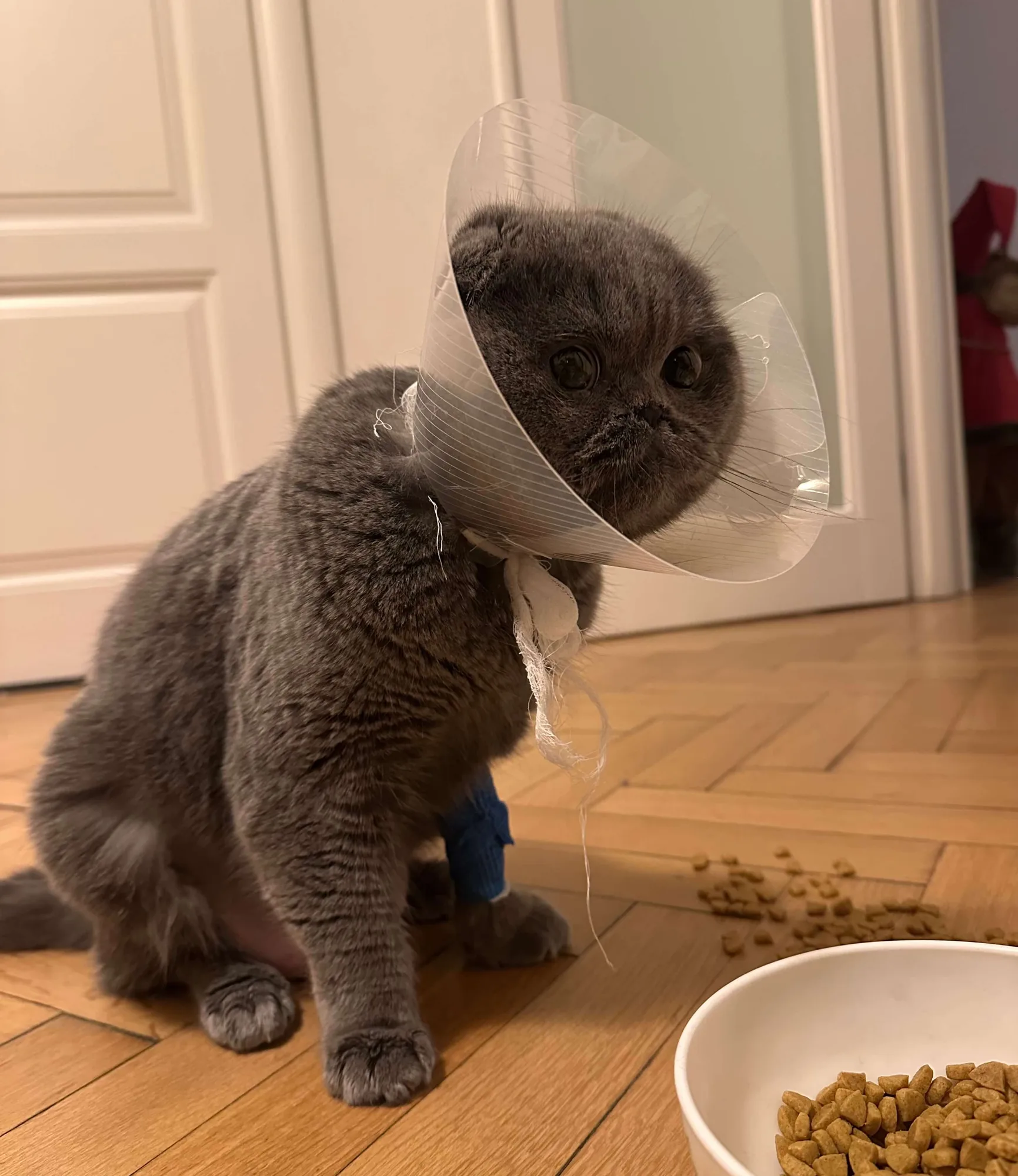
Only then did I truly see him. I saw how loving he is. How much he needs attention and love, and how willing he is to give them back, asking for nothing in return. He had been like that all along. I just hadn’t noticed. That’s when I understood how wrong I’d been.
I understood something else, too, and it hurt: Marbel won’t be by my side forever. His time is shorter than mine, and I’d spent most of it with my eyes on a screen.
It all happened during a hard time for me as well. Work had worn me down so much that the exhaustion had started to affect my health. It was no longer a choice: I had to stop. Even for just a few moments a day, to do something only for myself. To disconnect, to be present, to take a break.
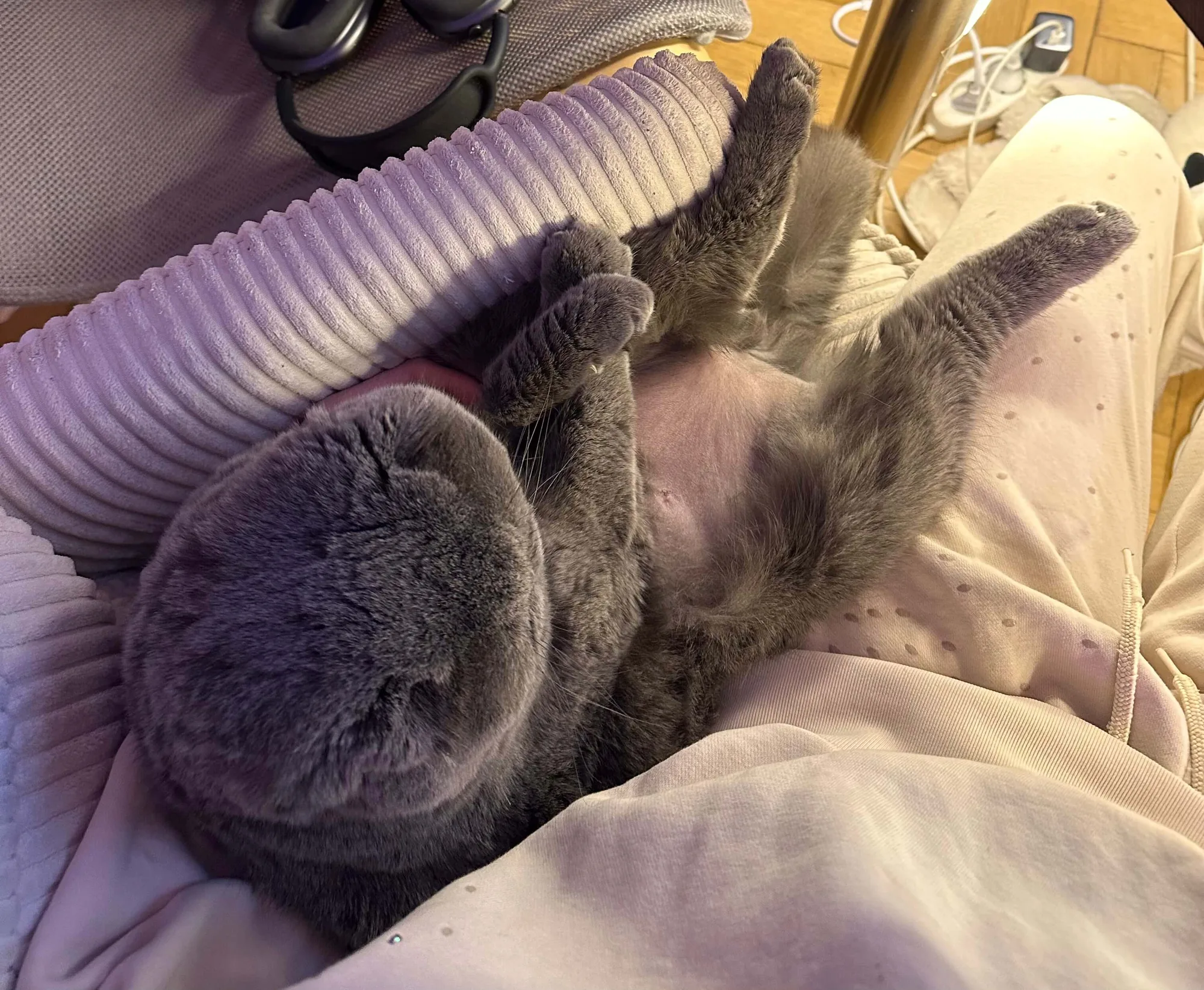
I bought a few coloring books. And in the evenings, with Marbel close by, I started to color. The world didn’t collapse. The messages waited. The projects stayed exactly where they were. I, on the other hand, started to change.
A story many of us live
For a long time I thought it was only my problem. Then I started reading, and I saw it’s a problem with the way we live.
[H3] When busyness became a badge of worth
Silvia Bellezza, Neeru Paharia and Anat Keinan, researchers at Columbia, Georgetown and Harvard, showed in a series of studies that always being busy has become a status symbol. People seem more important to others when they say they “have no life.” Interestingly, the effect reversed for participants in Italy, where a more leisurely life still signals status.
In other words, busyness isn’t fate. It’s a value we learn, and one we can rethink.
[H3] Home in body, away in mind
Harvard psychologists Matthew Killingsworth and Daniel Gilbert followed 2,250 adults through an app that asked them, at random moments, what they were doing and what they were thinking about. Almost 47% of the time, people’s minds were somewhere other than what they were doing. And they were less happy when that happened, whatever the activity.
The phone adds another layer. Andrew Przybylski and Netta Weinstein, of the University of Essex, found that the mere presence of a phone on the table, even one that belonged to no one in the room, made conversations feel colder. The effect was strongest exactly when people were talking about something that mattered to them.
I recognize myself in these numbers. Maybe you do too.
[H3] Connected, and still alone
In June 2025, the World Health Organization’s Commission on Social Connection published a report saying that about one in six people worldwide is affected by loneliness. The report links it to more than 871,000 deaths a year, around a hundred every hour. And it notes a paradox many of us feel: even though we’re digitally connected all the time, many young people feel alone.
[H3] The tiredness we see in others
In Romania, a February 2025 study by Reveal Marketing Research found that 65% of respondents don’t feel professionally fulfilled. 66% said they’d seen colleagues affected by burnout, rising to 74% among people aged 25 to 34. These are numbers about work, but tiredness doesn’t stay at the office. It comes home with us, sits on the couch next to us, and keeps our eyes on the phone even when someone we love is waiting.
[H2] What a being who waits for you does
I don’t think an animal solves any of this. But I do think it can show us what we’re missing.
At Washington State University, Patricia Pendry and Jaymie Vandagriff split 249 students into four groups. Those who petted cats and dogs for ten minutes had lower levels of cortisol, the stress hormone, than those who only watched the animals, looked at photos of them, or simply waited. The researchers speak of momentary relief, not a cure. But ten minutes can matter.
For me, Marbel meant more than a dropping hormone. He was a mirror. He didn’t care about my achievements, and that made me ask why I cared about them so much. And whether everything I’d gained by running was worth everything I’d lost along the way.
[H2] Why coloring books
Coloring began as a break I needed. Over time, it became a promise: every evening, I color one page with Marbel in my arms. One hour in which I’m fully there, no matter how full the day has been.
As a creative person, creating is how I recharge. So at some point, I wanted to draw these pages myself, for anyone going through what I went through.
Marbel Loves was born from that promise. The pages have bold lines and large areas, so you can start and finish them in a single evening. That means one thing carried to the end on a day when, maybe, nothing else was. The characters, Dottie, the bunny with two bows, or Trixie, the little fox, are sometimes clumsy, tired, other times full of energy. Just like us. They aren’t drawn to be perfect. They’re drawn so you can recognize yourself in them.
I don’t claim a coloring book changes a life. For me, though, that evening hour changed the way I look at my day.
[H2] Your Marbel has another name
I like to say that Marbel Loves exists in everyone’s life, just under a different name. For you, maybe it’s a mother who calls on Sundays and whom you answer in a hurry. A friend who keeps inviting you for coffee and whom you keep putting off. A child who shows you a drawing just as your hands are on the keyboard. A cat, a dog, a plant you forget to water. Or even you, the part of you that would like to sit for an hour without producing anything.
If you like, try three small things tonight:
Leave your phone in another room for an hour. Not forever, just for an hour.
Really look at someone you love and ask them something. Then listen to the whole answer.
Do one single thing, from start to finish. A colored page, a cooked dinner, a short walk.
Nothing that matters will fall apart. It’s just that, maybe, you’ll see something you didn’t see before.
[H2] The Marbel Loves family
I’m not writing all this because I’ve found the answer. I’m still learning, every evening. Some days the list wins and I find myself with the laptop in my arms instead of Marbel. But now I notice when it happens, and I can come back.
We call the community around these books the Marbel Loves family. They’re people who’ve chosen, for at least an hour a day, to stop. If you’d like to be part of it, show us your page with @marbel.loves, or tell us your Marbel’s name. And if you recognize yourself in the hurry I wrote about, read “Why You Don’t Finish What You Start (and What Helps)” too.
Sources
Bellezza, S., Paharia, N. și Keinan, A., „Conspicuous Consumption of Time”, Journal of Consumer Research, 2017: https://www.sciencedaily.com/releases/2017/03/170322122631.htm
Killingsworth, M. A. și Gilbert, D. T., „A Wandering Mind Is an Unhappy Mind”, Science, 2010: https://www.medicalnewstoday.com/articles/207620.php
Przybylski, A. K. și Weinstein, N., „Can you connect with me now?”, Journal of Social and Personal Relationships, 2013: https://orca.cardiff.ac.uk/id/eprint/72345
Organizația Mondială a Sănătății, raportul Comisiei pentru Conexiune Socială, iunie 2025: https://www.who.int/news/item/30-06-2025-social-connection-linked-to-improved-heath-and-reduced-risk-of-early-death
Reveal Marketing Research, studiu despre burnout, februarie 2025: https://economedia.ro/?p=242759
Pendry, P. și Vandagriff, J. L., „Animal Visitation Program (AVP) Reduces Cortisol Levels of University Students”, AERA Open, 2019: https://news.wsu.edu/press-release/2019/07/15/study-demonstrates-stress-reduction-benefits-petting-dogs-cats/