It's November, your phone is in your hand and your gift list is only half done. One name stops you: someone you love who, for months now, seems to be running on empty. They no longer feel like going out, they eat on the run, they answer messages half a day late. Everything you think of buying them feels either too small, or like one more thing they'll have to find a place for.
The short answer: the best gift for someone tired is one that gives them time or a break and asks for nothing in return. No deadline to meet, no instructions to read, no extra object to keep in the house. Below you'll find why this works, what the research says about gifts, and six ideas you can put together before December.
Why we usually pick the wrong gift
We think about the unwrapping moment
Jeff Galak, a professor at Carnegie Mellon, together with Elanor Williams and Julian Givi, reviewed several studies on gift-giving mistakes. Their conclusion, published in Current Directions in Psychological Science: the giver thinks mostly about the moment the gift is opened, the smile, the surprise. The receiver thinks about how useful and enjoyable the gift will be over time.
For someone exhausted, the difference is felt even more. The surprise lasts ten seconds. A quiet evening or one less worry is felt for a long time afterwards.
Price doesn't buy appreciation
Francis Flynn and Gabrielle Adams of Stanford showed in a 2009 study that givers believe a more expensive gift will be more appreciated. Receivers, in fact, don't link their appreciation to price. Probably because they sense how much you thought about them faster than how much you paid.
How many people around us are at their limit?
In a Reveal Marketing Research study from February 2025, carried out on 1,000 respondents, 65% of Romanians said they don't feel professionally fulfilled. The main sources of stress were the heavy workload (64%) and taking on excessive responsibility (50%). These are numbers about work, but tiredness doesn't stay at the office. It comes home with the people carrying it.
What research says about experiences
Cindy Chan and Cassie Mogilner compared, across four studies, object gifts with experience gifts. They published the results in the Journal of Consumer Research: experiences strengthen the relationship between giver and receiver more, because they trigger stronger emotions when lived. Still, 78% of respondents said their last gift had been an object.
The researcher adds one useful thing for tired people: an experience should be given without a fixed date or time. A ticket with an expiry date, in a crowded month, becomes one more task.
Six ideas that add nothing to anyone's list
Gifts that give time
A cooked meal, brought to their home. A few portions of what they love, in containers they don't have to return.
An afternoon of chores done by you. Shopping, light cleaning, a washed car. You write it on a voucher: “You pick the day”.
Gifts that give a break
An evening organised from start to finish. You pick the film, you make the food, and the other person has no decisions to make. Make it a voucher with no date, valid anytime.
A massage or a spa visit, also with no deadline. If you can, choose one that doesn't ask for an immediate booking.
A walk planned together, no phones. The gift is your time, not the route.
Something to do with their hands, with no goals. Colouring books belong here, but only for someone who enjoys creating.
About colouring, without exaggeration
Nicola Holt, from the University of the West of England, tested in two studies, with 47 and 52 students, how people's state changes after 20 minutes of colouring or reading. After colouring, participants reported feeling calmer and more focused. In the second study they also did better on attention and original ideas. The author herself says the results need to be replicated. Colouring doesn't treat exhaustion. It can be one hour in which you have nothing left to decide.
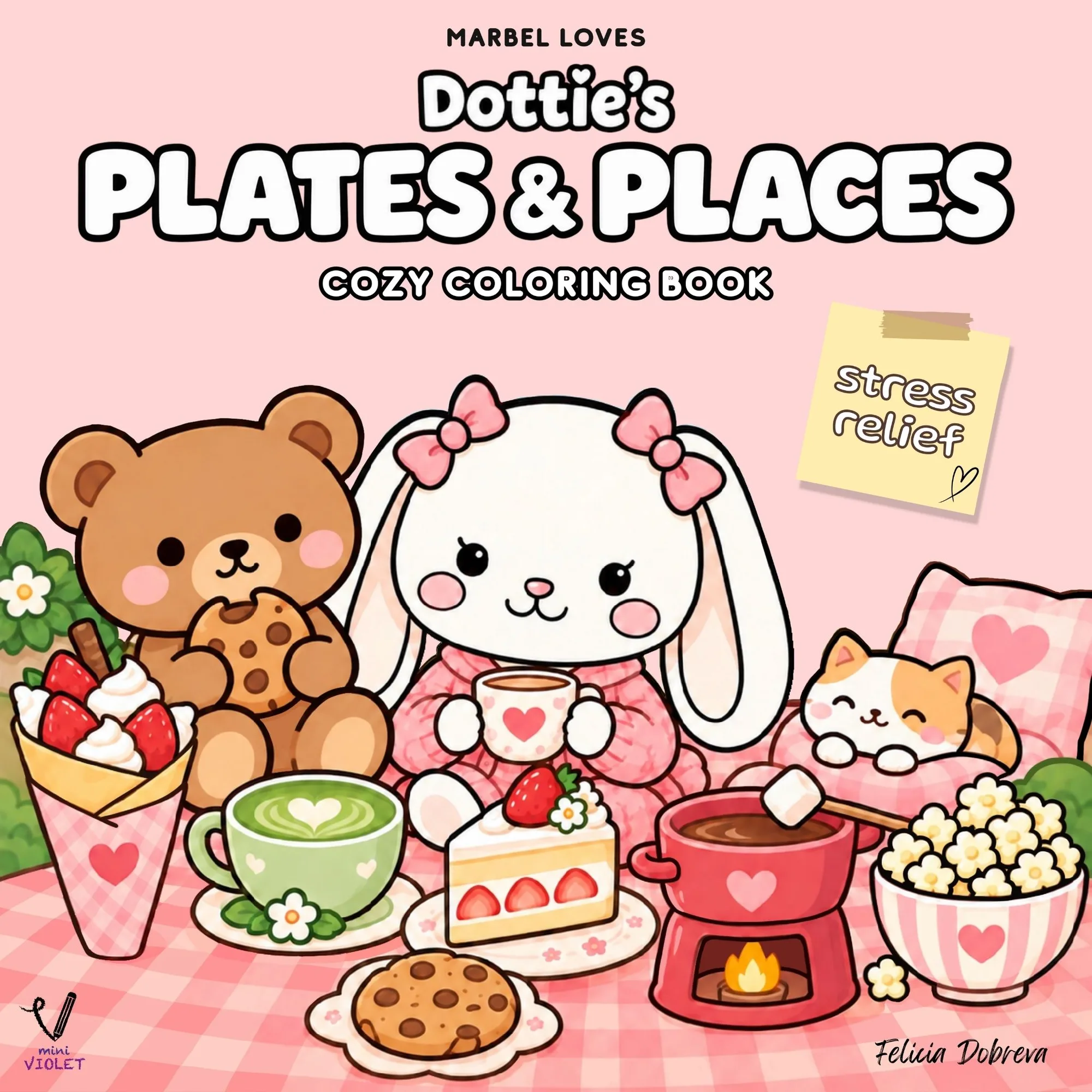
If you're thinking of a book, choose it for the way it ends: one page per evening, with thick lines, on 140 gsm paper, that you can start and finish within an hour. “Dottie's Plates & Places” has 44 illustrations of dishes and moments with Dottie and her friends. If the person isn't the colouring type, don't push it. Pick from the other five.
How to find out what would help, without ruining the surprise
Another study by Flynn, together with Francesca Gino, showed that people appreciate gifts they asked for more than ones chosen by others. They also see them as more thoughtful. Givers don't anticipate this. So instead of guessing, ask. Not “what do you want for Christmas?”, but:
If you had three free hours, what would you do?
What have you set aside because you no longer have the energy?
What's one thing you'd happily hand over to someone else to do?
What to avoid
As a simple rule: if the gift comes with a task, a tired person will feel it as one more. Planners “to be more organised”, courses, subscriptions with goals and assembly kits all go in exactly the opposite direction.
A thought for the ending
For me, the evening hour with Marbel in my arms has come to be worth more than any object I could have bought. That's where I start when I choose a gift too: what gives the other person an hour in which they no longer hurry?
If you end up gifting a colouring evening, we'd love to see the pages — tag @marbel.loves. And if you need a thought about the things we keep postponing, read our article “Why You Don't Finish What You Start (and Why One Small Thing Matters)”.
Sources
Galak, J., Givi, J. and Williams, E. F., “Why Certain Gifts Are Great to Give but Not to Get”, Current Directions in Psychological Science, 2016: https://www.cmu.edu/piper/news/archives/2016/december/gifting-errors.html
Flynn, F. J. and Adams, G. S., “Money Can't Buy Love”, Journal of Experimental Social Psychology, 2009: https://www.gsb.stanford.edu/faculty-research/publications/money-cant-buy-love-asymmetric-beliefs-about-link-between-gift-price
Flynn, F. J. and Gino, F., on requested gifts, Stanford GSB, 2011: https://www.gsb.stanford.edu/insights/give-them-gift-theyre-expecting
Chan, C. and Mogilner, C., “Experiential Gifts Foster Stronger Social Relationships than Material Gifts”, Journal of Consumer Research, 2017: https://www.utoronto.ca/news/science-gift-giving-u-t-research-best-kind-present-receive
Holt, N. J., Furbert, L. and Sweetingham, E., “Cognitive and affective benefits of coloring”, Art Therapy, 2019: https://uwe-repository.worktribe.com/output/848019/cognitive-and-affective-benefits-of-coloring-two-randomized-controlled-crossover-studies
Reveal Marketing Research, burnout study, February 2025: https://www.revistabiz.ro/doar-35-dintre-romani-sunt-fericiti-la-locul-de-munca/