Someone tells you: “try colouring, it relaxes you”. You have thirty tabs open, a to-do list that never ends, and the idea of colouring in a little bunny seems, at best, cute. You might reasonably wonder whether it's just a trend that has filled the bookshop shelves.
The short answer: several small studies show that after 10–20 minutes of colouring, people report less unease. The evidence is still in its early days, though. Participants are often students, the groups are small, and other creative activities seem to do something similar. Colouring doesn't treat anxiety. It can be a pause with a clear beginning and end — and that already has value.
What the studies show
Twenty minutes, three sheets of paper
In 2005, Nancy Curry and Tim Kasser of Knox College asked students to write briefly about an event that had frightened them, then to colour for 20 minutes. There were 84 participants in three groups: some coloured a mandala, others a plaid pattern, others drew freely on a blank sheet. The mandala clearly lowered anxiety, the plaid somewhat less, and the blank sheet not at all. A 2012 replication by Renée van der Vennet and Susan Serice confirmed that the mandala reduces anxiety more than the plaid or the empty page.
Ten minutes a day, for a week
At the University of Otago in New Zealand, Jayde Flett and her colleagues split 115 women aged 18 to 36 into two groups. Some coloured for ten minutes a day; the others solved logic puzzles. After a week, only the colouring group reported fewer depressive symptoms and less unease. An interesting detail: both groups showed a small rise in mindfulness. The researchers concluded that mindfulness doesn't seem to be the explanation.
More attention, more ideas
Nicola Holt, from the University of the West of England, compared 20 minutes of colouring a mandala with 20 minutes of reading, in two studies with 47 and 52 students. After colouring, participants reported feeling calmer and more attentive to what they were doing. In the second study they also scored better on an attention test and came up with more original ideas.
What hasn't been proven yet
It's not the only activity that works
Jennifer Forkosh and Jennifer Drake induced a sad mood in participants, then had them either colour or draw. Both groups felt better, except that colouring produced more absorption — that “I'm lost in what I'm doing” feeling. In another study, Girija Kaimal of Drexel University gave adults 45 minutes to create whatever they wanted: drawing, clay, collage. In 75% of them, levels of cortisol, the stress hormone, dropped, regardless of their experience in art. But in 25% it rose. Nicola Holt also notes that several studies found effects across all the artistic activities tested, which makes it hard to say what exactly matters about colouring.
The mechanism isn't clear
It's often said that colouring works because it brings mindfulness. The data doesn't clearly confirm that. In the Otago study, mindfulness rose just as much in the puzzle group. Curry and Kasser suggested, for their part, that the blank sheet may not have helped precisely because you have to decide what to draw yourself — and that takes effort.
The evidence is still fragile
A 2022 meta-analysis published in Art Therapy gathered only eight studies, with 578 participants in total. The authors noticed that larger effects appear in the less precise studies, which suggests possible bias, and they describe the evidence on colouring as sparse and ambiguous. Holt adds that many measurements rely on what participants say about themselves, and that can be influenced by what they expect to happen.
If your unease is constant, ruins your sleep or empties your days, talk to a doctor or a psychologist. Colouring can sit alongside that help, not in its place.
What remains, for an ordinary evening
Put together, what the studies say is modest and yet useful: a small activity, with simple rules, that holds your attention without asking for big decisions, and that comes to an end. For many people, that happens to be exactly the pause they need.
How to try it
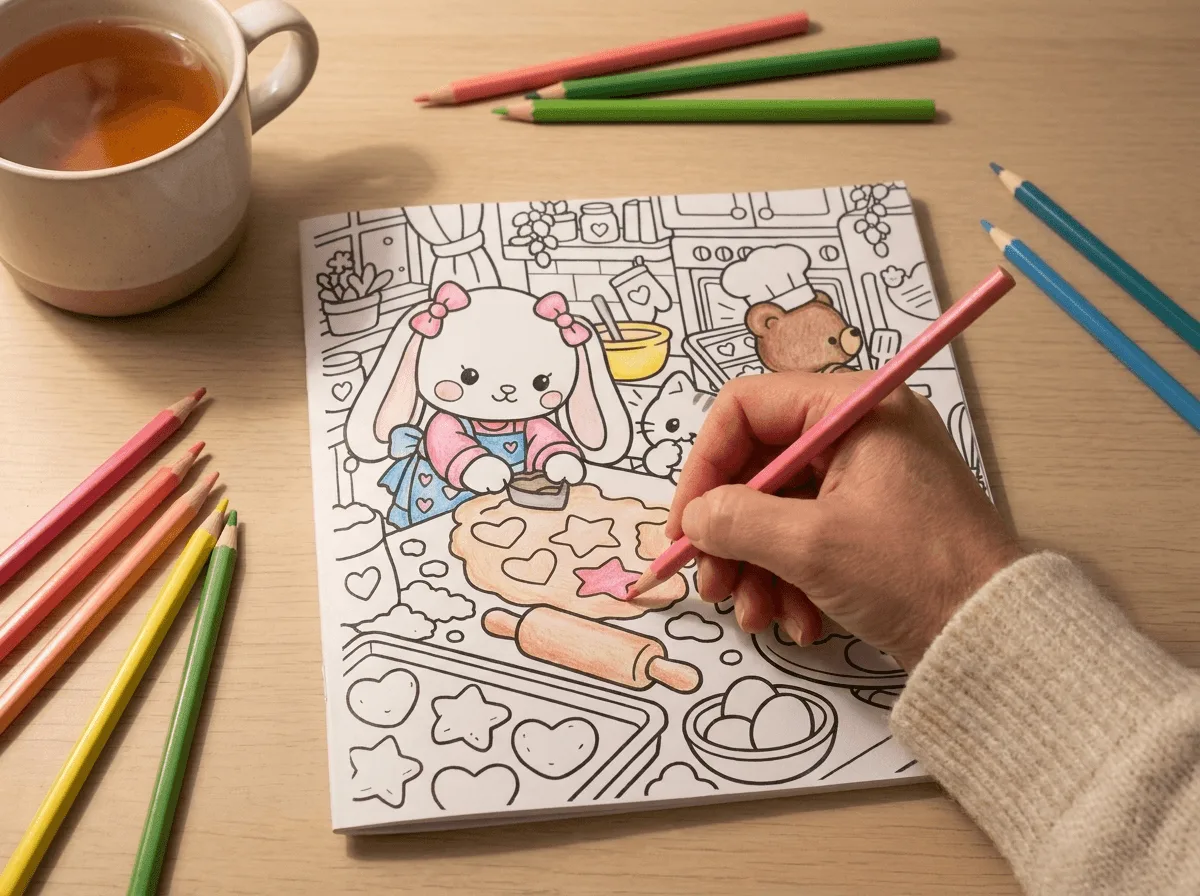
Choose a page with clear lines and large areas. In Curry and Kasser's study, the blank sheet didn't help. A ready-made structure lifts a decision off your shoulders.
Set a timer for 20 minutes, like in the studies. Not so you have to stop, but so you know there's an ending.
Pick colours with no rules. There are no wrong combinations.
Don't check whether it's working. If at minute five you ask yourself “am I relaxing?”, return to the page.
Let the lines be crossed. Going outside the outline is part of the page.
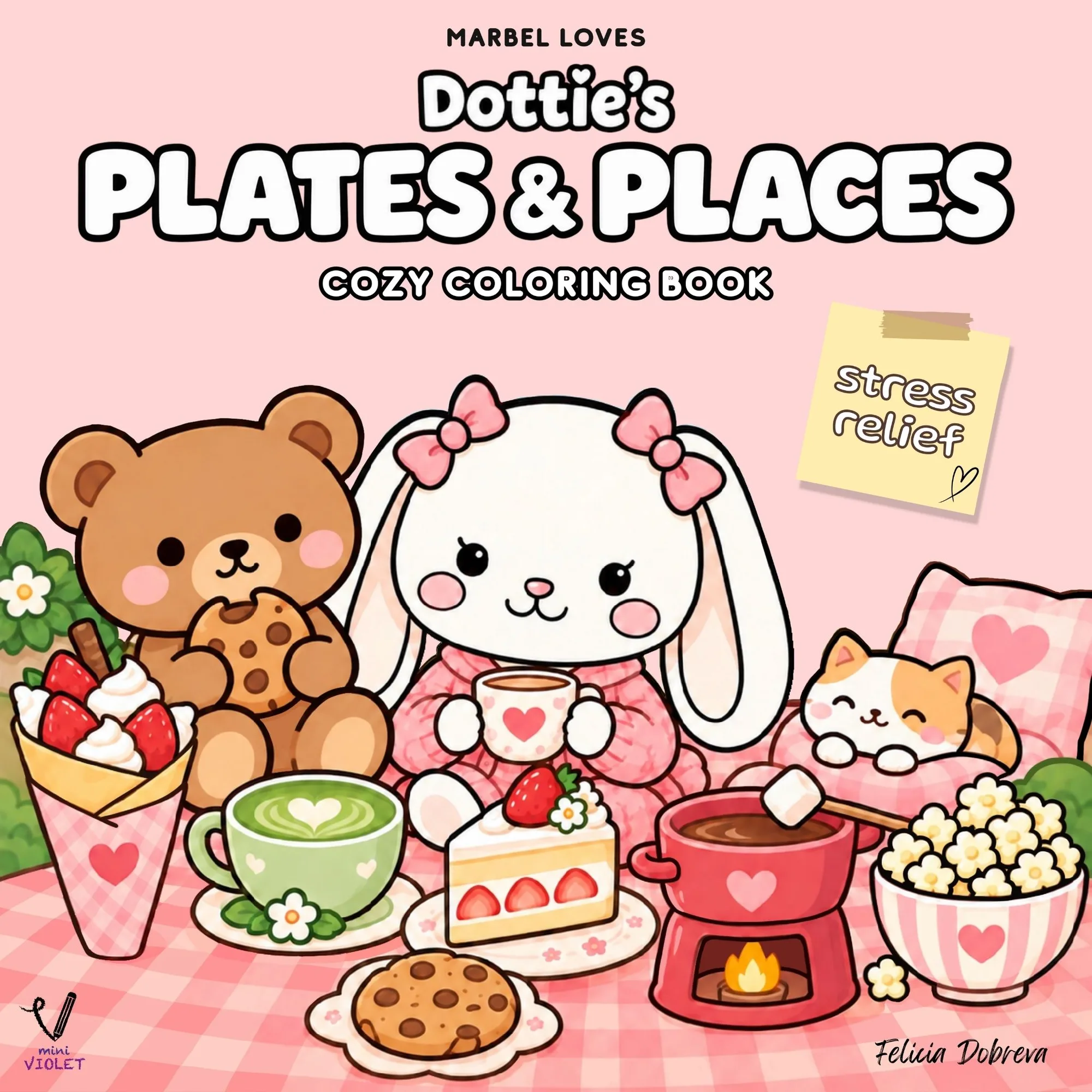
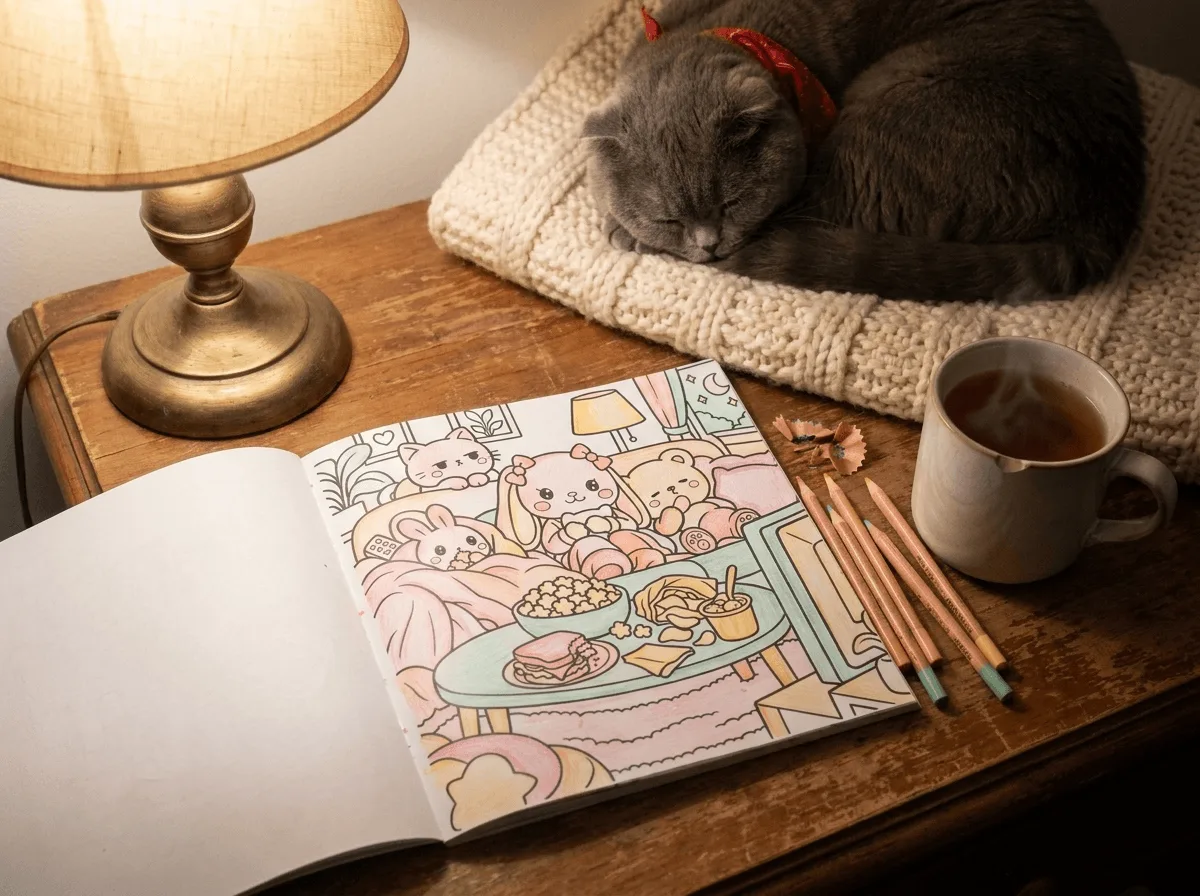
In my evening ritual, with Marbel in my arms, I don't ask myself whether it works. It's enough that, for one hour, I'm not doing anything else. Our pages have thick lines and large areas precisely so you have no tiny decisions to make: you can start and finish a page this very evening.
A thought for the ending
Colouring doesn't work miracles, and the studies don't claim it does. What it offers you is an hour with clear edges, in which your hands have something to do. If you try it, show us your page with @marbel.loves. And if your list of started things is long, also read “Why You Don't Finish What You Start (and Why One Small Thing Matters)”.
Sources
Curry, N. A. and Kasser, T., “Can Coloring Mandalas Reduce Anxiety?”, Art Therapy, 2005: https://www.tandfonline.com/doi/abs/10.1080/07421656.2005.10129441
van der Vennet, R. and Serice, S., “Can Coloring Mandalas Reduce Anxiety? A Replication Study”, Art Therapy, 2012: https://informahealthcare.com/doi/abs/10.1080/07421656.2012.680047
Flett, J. A. M. et al., “Sharpen Your Pencils”, Creativity Research Journal, 2017: https://ourarchive.otago.ac.nz/esploro/outputs/journalArticle/Sharpen-Your-Pencils-Preliminary-Evidence-that/9926515195401891
Holt, N. J. et al., “Cognitive and affective benefits of coloring”, Art Therapy, 2019: https://uwe-repository.worktribe.com/output/848019/cognitive-and-affective-benefits-of-coloring-two-randomized-controlled-crossover-studies
Holt, N., “Colouring for wellbeing: Evidence and applications”: https://uwe-repository.worktribe.com/OutputFile/9294488
Forkosh, J. and Drake, J. E., “Coloring versus Drawing”, Art Therapy, 2017: https://dx.doi.org/10.1080/07421656.2017.1327272
Kaimal, G. et al., “Reduction of Cortisol Levels and Participants' Responses Following Art Making”, Art Therapy, 2016: https://drexel.edu/news/archive/2016/june/art_hormone_levels_lower
Jakobsson Støre, S. and Jakobsson, U., “Therapeutic coloring and anxiety: A systematic review and meta-analysis”, Art Therapy, 2022: https://informahealthcare.com/doi/full/10.1080/07421656.2021.2003144