
It’s almost midnight. On the desk there’s a list started on Monday, with nothing crossed off. On your phone, three projects are waiting for “tomorrow.” On the nightstand, a book bookmarked at page 40, sometime back in March. And the thought arrives almost on its own: another day wasted.
If that scene feels familiar, you’re far from the only one. Most of the time, you don’t finish what you start for two reasons that have nothing to do with laziness. First, you measure your day only by the big steps, so anything small seems worthless and gets dropped along the way. Second, unfinished things don’t disappear when you close your laptop. They stay on your mind and use up the attention you need for everything else.
Both can be softened with something very small: one thing, finished, today.
Why we start a lot and finish little
A day measured in mountains
We want to build mountains, and we want them done fast. We have plans for our career, our body, our home, our relationships, and all of them feel urgent at once. But a day has 24 hours, not 100. Put it next to a to-do list meant for a whole week, and every day comes up short.
Harvard Business School professor Ashley Whillans calls this time poverty: the feeling of having too much to do and too little time to do it. In a dataset of around three million Americans, more than 80% said they didn’t have enough time for everything they wanted or needed to do. In her research, time stress hurt happiness even more than unemployment did.
The feeling doesn’t come only from how many hours we have. It also comes from how we judge them. An evening where you cooked, called someone you love and read ten pages can feel empty if the only thing that counts is the big project that didn’t move.
What unfinished things do to your mind
Psychology has a name for the way started tasks follow us around: the Zeigarnik effect. It is named after psychologist Bluma Zeigarnik, who showed that we remember unfinished tasks more easily than completed ones.
In 2011, E.J. Masicampo and Roy Baumeister took this further in a series of experiments published in the Journal of Personality and Social Psychology. Unfulfilled goals caused intrusive thoughts while participants were reading something else, and made them perform worse on unrelated tasks. When participants made a specific plan for what was left unfinished, those effects disappeared.
Every task you start and leave hanging is like a window left open in your mind. Ten open windows make quite a draft. No wonder that in the evening, instead of resting, you keep thinking about them.
What one small finished thing does
Teresa Amabile and Steven Kramer of Harvard Business School followed employees’ daily diaries to understand what shifts their mood from one day to the next. They called their finding the progress principle: small steps forward in work that matters. According to the researchers, 28% of minor events had a major impact on how people felt, while big breakthroughs were rare.
If big leaps are rare, most good days are built from small steps. One small finished thing closes a window. It’s concrete proof that the day had an ending, not just a beginning.
What I’m still learning, with Marbel in my arms
I’m writing about this because I’ve lived it, and I still do. For a long time I believed that a day without a big step was a day thrown away. I started a lot and enjoyed very little, because my mind was already on the next mountain.
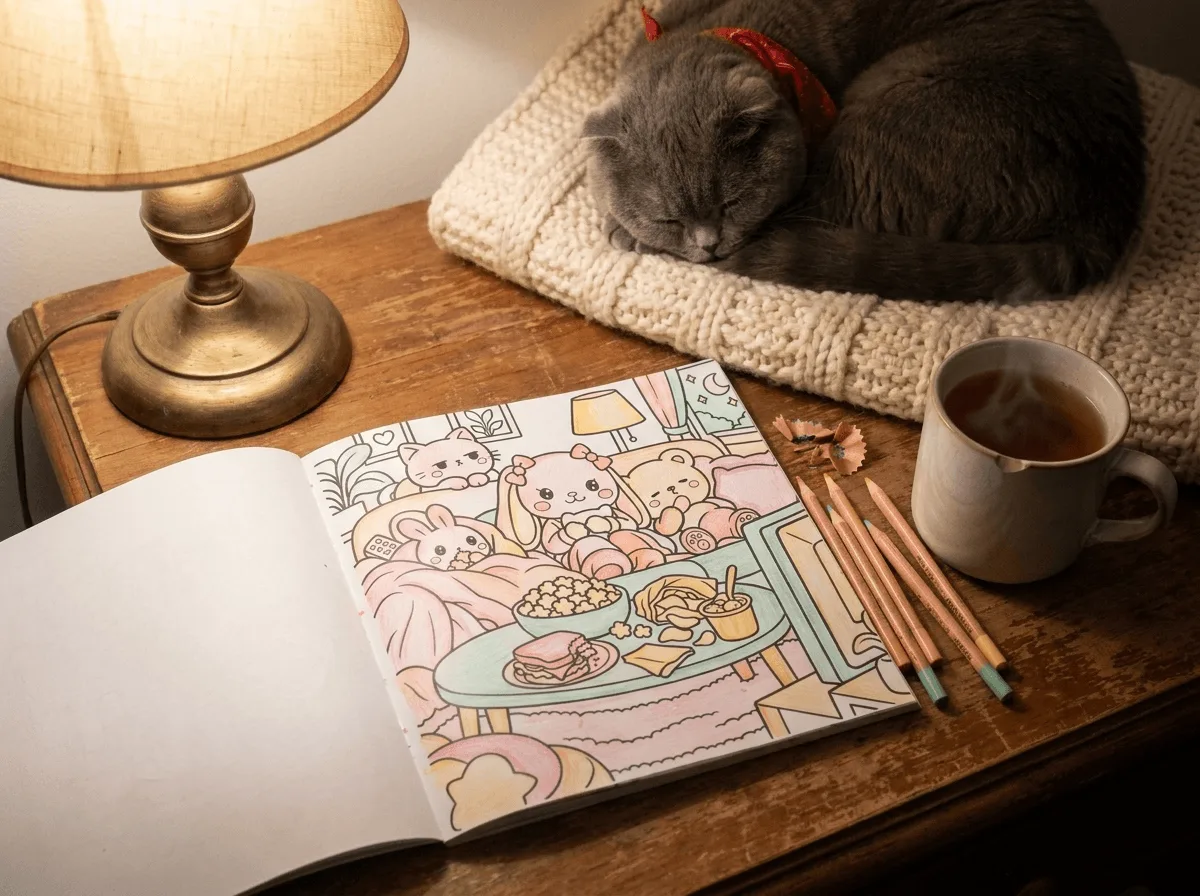
What stopped me was something very small: a cat. Marbel waited for me at home every evening, no matter what my day had been like, and I was in too much of a hurry to notice him. That’s how I came to a simple promise: every evening, I color one page with him in my arms. One hour where I’m truly there.
I haven’t figured everything out. Some evenings, the list pulls me back to the laptop. But I learned something I didn’t expect: the world carries on just fine without me for an hour. I, on the other hand, get up from the couch a little different. And sometimes that page is the only thing from the whole day I can look at and say: done.
How to pick your small thing, tonight
It needs an ending you can see
The most useful rule is simple: choose something that takes an hour at most and has an ending you’ll recognize right away. A tidied drawer. A sent letter. A recipe cooked from start to finish. A coloring page.
This is also why coloring works for so many of us. In a study published in Art Therapy, Nancy Curry and Tim Kasser compared three groups. Some participants colored a mandala for 20 minutes, others a plaid pattern, and others drew on a blank sheet. The mandala group reported a clear drop in anxiety, the plaid group a smaller one, and free drawing changed nothing. The authors suggested that having no direction, having to decide for yourself what to draw, can be demanding in itself.
A ready-drawn page takes one decision off your shoulders and gives you a clear ending. At Marbel Loves, we drew our pages with bold lines precisely so they can be started and finished in a single evening.
Write down the rest, with a day and time
The big things don’t go away. But you can give them somewhere to wait. Before you start your small thing, write down what’s left unfinished and when you’ll come back to it. Be specific: “Thursday at 10, I open the presentation,” not “sometime this week.” Masicampo and Baumeister’s findings suggest that a precise plan is enough for your mind to leave that window alone until then.
Let it be imperfect
A finished thing doesn’t have to be a perfect thing. The color can go outside the lines, and one corner of the drawer can stay messy. A mistake doesn’t cancel the fact that you finished.
Name what you finished
In the evening, before bed, try one sentence: “Today I finished…”. Not the list of what you didn’t do. It feels too small to matter, and that’s exactly why it works.
At the end of the day
Maybe tomorrow the list will be just as long, and the mountain will still be there. But if tonight ends with one thing finished, the day wasn’t wasted. It had an ending, and you were there when it happened.
Pick your small thing right now. If it’s a colored page, show it to the Marbel Loves family with @marbel.loves. We love every one of them, outside-the-lines moments included.